Mortgage

How Much of Your Income Should Go Toward a Mortgage?
-
Brady Webb

Before you spend a Saturday looking at houses, I’d ask you one question. What monthly payment would you still feel good about after you’ve paid the rest of your bills?
That’s where I like to start with buyers. We’ll look at what you may qualify for, and we’ll also look at what fits your life. I want you to enjoy the house and still have room to take a trip, go out to dinner, and handle it when the air conditioner quits.
What percentage of your income should you budget for housing?
I'd start by looking at 25% to 30% of your gross monthly income (before taxes) for your home payment. If you want more breathing room, try 25% of your take-home pay as a more conservative starting point. These are budgeting guidelines. Your loan program and financial profile determine what you may qualify for.
Say your household earns $8,000 a month before taxes, takes home $6,000, and pays $800 a month toward other debts. Here’s how the guidelines compare.
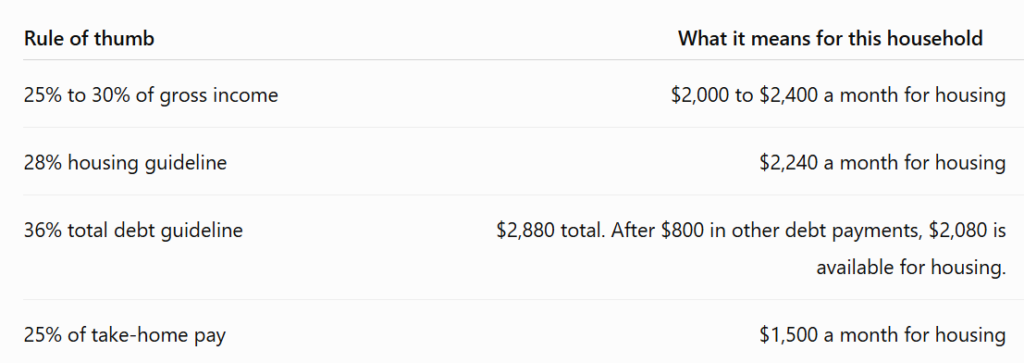
Under the 28/36 rule, I’d use $2,080 as the starting point because it’s the lower of the two limits. If childcare costs are about to go up or your income varies month to month, I’d give yourself more room.
What does that payment actually cover?
Let’s say you’re comfortable with $2,080 a month for your home payment. If you estimate $300 for property taxes, $200 for homeowners insurance, and $100 for HOA dues, that leaves $1,480 for principal and interest.
If the property also needs $150 a month in flood insurance, that drops to $1,330. Include mortgage insurance if it applies, and budget separately for utilities, maintenance, and repairs. This is where I like to run the numbers on the specific house. Two homes with the same asking price can cost you different amounts each month.
How much cash should you keep after closing?
One stricter benchmark is the 30/30/3 guide. It limits the home payment to 30% of gross income, caps the purchase price at three times annual gross income, and calls for cash equal to 30% of the home price, with 20% for the down payment and 10% kept in reserve. For the household above, three times its $96,000 annual income is $288,000.
When I sit down with buyers, I like to look at what they’ll have left after the down payment, closing costs, and move. The CFPB suggests keeping an emergency cushion of three to six months of expenses. How much you set aside matters just as much to your day-to-day budget as the check you bring to closing.
Bottom Line
If you’re thinking about buying, let’s start with your monthly income, debt payments, and what you’d like to put down. We’ll work backward to a price range that fits your budget before you start touring homes.
If you’d like help walking through the process or want to see what your numbers look like. Feel free to reach out:
📍 Cape Coral, FL: (239) 766-8344
📍 Louisville, KY: (502) 327-9770

Do you know how much home you can afford?
Most people don’t... Find out in 10 minutes.

Your Mortgage Broker in Cape Coral FL & Louisville KY. We are licensed in Florida, Kentucky, and Indiana.
- Services
- Blog
- Locations
- Contact



Copyright © 2026 | American Mortgage Solutions | NMLS: 1364/MB73346
Licensed in: FL, KY, IN
FL-MBR1574, KY-MB73346
Copyright © 2026 | American Mortgage Solutions | NMLS: 1364/MB73346
Licensed in: FL, KY, IN
FL-MBR1574, KY-MB73346
American Mortgage Solutions follows all Equal Housing laws. As prohibited by federal law, we do not engage in business practices that discriminate on the basis of race, color, religion, national origin, sex, marital status, age, because all or part of your income may be derived from any public assistance program, or because you have, in good faith, exercised any right under the Consumer Credit Protection Act. Disclaimer: Programs subject to change without notice. All borrowers must qualify per program guidelines.
These materials are not from HUD, FHA, the USDA, or the VA. These materials were not approved by any government agency. They are independent of any government agency. We are not in any way affiliated with any organization listed or referenced within this website, including HUD/FHA/USDA/VA. The inclusion of various education, information, web links, or materials are not an endorsement of the Sender or any of its employees or business partners. For information directly from HUD/FHA, visit https://www.hud.gov/guidance For information directly from the VA, visit http://www.benefits.va.gov/HOMELOANS/ For information directly from the USDA, visit http://www.usda.gov/wps/portal/usda/usdahome?navid=GRANTS_LOANS