Buying a home

What is Seller Concessions and Can it Help You Buy a Home?
-
Brady Webb

Saving for a down payment is a big step toward homeownership. But closing costs can add another hurdle.
Whether you’re buying in Louisville, Kentucky, or Cape Coral, Florida, seller concessions may help reduce the cash you need at closing. Here’s how they work and what to consider before making an offer.
What are seller concessions?
In everyday real estate conversations, seller concessions often means the seller agrees to pay part of the buyer’s eligible closing expenses. You may also hear “seller credit” or “seller-paid closing costs.”
Depending on your loan program, that contribution may cover:
- Lender fees and appraisal charges.
- Title, settlement, and recording fees.
- Prepaid interest, insurance, and eligible escrow deposits.
- Discount points or an approved temporary payment buydown.
The credit must be negotiated, documented, and approved by your lender. An ordinary seller closing-cost credit generally cannot cover your required down payment.
A simple example
Suppose you’re buying a $350,000 home with $10,000 in eligible closing costs and prepaid expenses. The seller agrees to a $7,000 credit.
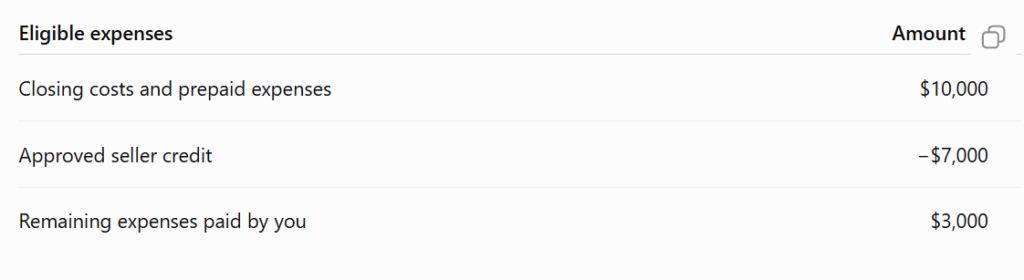
Assuming the full credit is allowed and usable, that means $7,000 less of your own money toward those expenses.
Your down payment remains separate. Earnest money, prorations, other credits, and expenses paid before closing will also affect your final cash to close.
How much can a seller contribute?
The limit depends on your loan program and transaction.
Conventional: Limits vary by occupancy and loan-to-value ratio.
FHA: Interested parties may generally contribute up to 6% of the sales price toward eligible expenses.
VA: Certain seller concessions are limited to 4% of the home’s reasonable value. Ordinary buyer closing costs are treated separately, so 4% is not a blanket limit on everything a seller may pay.
Seller credit or lower price?
A lower purchase price may reduce your loan balance and monthly principal-and-interest payment. A seller credit may do more to reduce your immediate out-of-pocket closing expenses.
Neither option is automatically better. Compare your cash needed to close, monthly payment, and savings remaining afterward. If using the credit toward discount points, compare the upfront cost with the potential payment savings.
Increasing the offer price to include a credit does not guarantee approval. The transaction still needs to meet appraisal and underwriting requirements.
What should local buyers consider?
In Louisville, Kentucky: Build a budget that includes property taxes, homeowners insurance, and repairs identified during inspections. Discuss repair requests separately from closing-cost credits, especially when a condition must be corrected before closing.
In Cape Coral, Florida: Get property-specific homeowners insurance quotes early and evaluate flood insurance needs. For waterfront homes, include the seawall, dock, and boat lift in your due diligence.
In either city, a credit may help preserve savings, but it does not eliminate maintenance costs or replace a thorough inspection.
Start with the numbers
Before submitting an offer, ask your mortgage professional to estimate your closing expenses and confirm how much seller credit your loan allows. Your real estate agent can then negotiate based on the property, competing offers, and the seller’s priorities.
At American Mortgage Solutions, we help Louisville and Cape Coral buyers compare financing options and understand the full picture.
Have a home in mind? Let’s review your numbers before you make an offer.
📞 Contact Brady Webb
🌴 American Mortgage Solutions
📍 Cape Coral, FL: (239) 766-8344
📍 Louisville, KY: (502) 327-9770
Seller contributions require seller agreement and lender approval and are subject to program limits, eligible expenses, and appraisal requirements. Example is illustrative, not a commitment to lend. Guidelines may change.

Do you know how much home you can afford?
Most people don’t... Find out in 10 minutes.

Your Mortgage Broker in Cape Coral FL & Louisville KY. We are licensed in Florida, Kentucky, and Indiana.
- Services
- Blog
- Locations
- Contact



Copyright © 2026 | American Mortgage Solutions | NMLS: 1364/MB73346
Licensed in: FL, KY, IN
FL-MBR1574, KY-MB73346
Copyright © 2026 | American Mortgage Solutions | NMLS: 1364/MB73346
Licensed in: FL, KY, IN
FL-MBR1574, KY-MB73346
American Mortgage Solutions follows all Equal Housing laws. As prohibited by federal law, we do not engage in business practices that discriminate on the basis of race, color, religion, national origin, sex, marital status, age, because all or part of your income may be derived from any public assistance program, or because you have, in good faith, exercised any right under the Consumer Credit Protection Act. Disclaimer: Programs subject to change without notice. All borrowers must qualify per program guidelines.
These materials are not from HUD, FHA, the USDA, or the VA. These materials were not approved by any government agency. They are independent of any government agency. We are not in any way affiliated with any organization listed or referenced within this website, including HUD/FHA/USDA/VA. The inclusion of various education, information, web links, or materials are not an endorsement of the Sender or any of its employees or business partners. For information directly from HUD/FHA, visit https://www.hud.gov/guidance For information directly from the VA, visit http://www.benefits.va.gov/HOMELOANS/ For information directly from the USDA, visit http://www.usda.gov/wps/portal/usda/usdahome?navid=GRANTS_LOANS