

Punta Gorda · Charlotte County, FL

Punta Gorda draws buyers whose income does not fit a standard form.

Retirees living on distributions. Boaters relocating from out of state. Snowbirds converting a seasonal rental into a purchase. Self-employed people who moved here to stop commuting.

A family at home in Punta Gorda

Every one of those situations is financeable. They are just not financeable the same way — and a lender that only knows how to read pay stubs will say no when the right answer is yes.

Four buyers, four different routes

Which Punta Gorda buyer are you?

The retiree or downsizer

You are done working, or nearly. Your income is Social Security, a pension, IRA or 401(k) distributions, investment returns, or some combination — and possibly you hold substantial assets while showing modest reported income.

What matters for your file is how a lender documents and counts retirement income. Distributions generally need a documented history and evidence they will continue for a defined period. Non-taxable income like Social Security can often be grossed up, meaning a lender treats it as a larger figure for qualifying purposes because you pay no tax on it — a detail that can meaningfully increase what you qualify for, and one a surprising number of borrowers never hear about.

If your income looks small but your balance sheet does not, ask about asset-based qualifying. Some programs convert eligible assets into a qualifying income stream without requiring you to actually draw on them. This is the single most useful thing for many Punta Gorda buyers to know, and it is why a no from your bank is not the final answer.

Focus on: how your distributions are documented, whether non-taxable income gets grossed up, whether asset-based qualifying applies.

Retired couple reviewing their finances at home

The boater

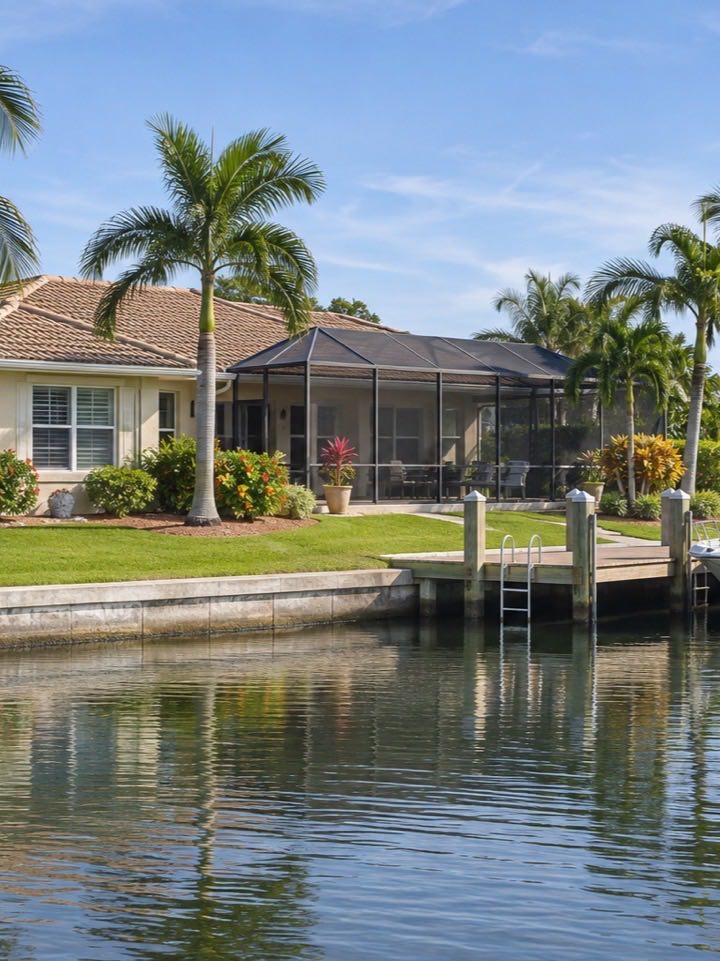
You came for the water — Punta Gorda Isles, Burnt Store Isles, Burnt Store Marina, or somewhere with a canal and a lift.

What matters for your loan is the appraisal. Waterfront value in Charlotte County depends heavily on sailboat versus powerboat access, bridge clearance, canal width, and distance from the harbour. Comparable sales have to reflect the same water classification, and when a waterfront appraisal comes in low, mismatched comps are usually why.

Seawall condition, dock and lift are underwriting items, not just amenities. On FHA and VA loans, where property-condition standards are stricter, a failing seawall can become a required repair before closing. And insurance — flood determination, elevation certificate, wind coverage — is part of your monthly payment and therefore part of your qualifying calculation.

Focus on: appraisal risk and comparable sales, seawall and dock condition, getting an insurance quote early.

A single-storey canal home with a private dock and screened lanai

The snowbird buying a second home

You have been renting seasonally and decided to buy. Maybe you will rent it out the months you are not here.

What matters for your loan is occupancy classification, which drives everything else. Second-home financing carries different down payment expectations, higher reserve requirements and different underwriting than a primary residence. If you plan to rent it, whether the lender classifies it as a second home or an investment property changes the terms again — and lenders do not all draw that line in the same place.

Settle this at pre-approval. Buyers who assume second-home terms and discover investment-property terms at underwriting lose deposits over it.

Focus on: pinning the occupancy classification before you offer, reserve requirements, how rental use changes the terms.

Couple enjoying a seasonal second home

The relocating family or working buyer

You moved to Charlotte County for cost of living, or you work in Punta Gorda, Port Charlotte, or the growing Babcock Ranch area.

What matters for your loan is the standard set of levers, done well. Charlotte County’s FHA limit is Florida’s floor of $541,287 for 2026, and the conforming limit is $832,750 — a wide band that almost every Charlotte County loan sits inside. Plenty of buyers who assumed FHA was their only low-down-payment path qualify for a 3% or 5% down conventional loan instead, often at lower long-term mortgage insurance cost.

Some Charlotte County addresses also qualify for USDA zero-down financing. It is address-specific and income-limited, but it is genuinely free money on the down payment if you are eligible.

Focus on: total carrying cost including assessments, low- and no-down conventional versus FHA, whether USDA applies.

Family moving into a new Charlotte County home

Cost of carry

What a Charlotte County property costs to hold

For buyers on a fixed or retirement income, the monthly carrying cost matters more than the headline price. This is the figure to plan around.

$

Assumptions — edit any of these

%
%
$
$
%

Estimated monthly cost to hold

$3,091/mo

Principal & interest$2,098/mo
Property tax$360/mo
Insurance$483/mo
Dues & assessments$150/mo

32% of this payment is not loan repayment. $993 a month goes to taxes, insurance and dues. Lenders count all of it against your debt-to-income ratio, which is why it changes what you qualify for and not just what you pay — and why it matters most to buyers whose income is fixed.

This is an illustration, not an offer. Figures are built from the assumptions above; your own rate, taxes, insurance premium and any assessments will differ. Mortgage insurance, flood insurance and closing costs are not included. A waterfront property in a flood zone will carry a materially higher insurance figure than the inland default shown here.

Brady Webb, President of American Mortgage Solutions
RolePresident, American Mortgage Solutions
Experience20+ years originating
LicensedFlorida, Kentucky & Indiana
NMLS#36093
Specialises inRetirement income, asset-based qualifying, second home

Meet your broker

Brady Webb

Twenty years of files that did not fit the box.

Brady Webb, President of American Mortgage Solutions, has been originating mortgages across Florida and Kentucky for more than two decades — long enough to have seen most of what Charlotte County brings through the door.

Retirees. Business owners. People with real assets and an unremarkable tax return. Buyers whose bank said no because the bank had one program and the borrower did not fit it.

Brady’s view is that most of those files were always approvable — they just needed to reach a lender who understood that kind of income. Finding that lender is the entire job of a mortgage broker.

Client experience

Why borrowers keep recommending us

5.0 from 100 reviews on Google. A few of them, in their own words.

★★★★★

“Brady and his team were fantastic! From dealing with Brady about my requirements and being nervous to know if I had all the requirements, Brady kept me at ease. He explained everything calmly and literally walked me each step of the way.”
AB
Alejandra BilbaoGoogle review

★★★★★

“I have worked with American Mortgage Solutions multiple times now, and as a repeat customer, I can confidently say they are the best in the business.”
KR
Kerry RexroadGoogle review

★★★★★

“He was super friendly and helpful. He communicates very well and definitely provides a high level of service. He is very good at explaining things in a way I understand.”
L
LorrieGoogle review

Questions

Punta Gorda
mortgage questions

Yes, routinely. Lenders can qualify you on Social Security, pension income and retirement account distributions, provided the distributions have a documented history and evidence they will continue. Non-taxable income can often be grossed up. And if you hold significant assets but show low income, asset-based qualifying may work. This is one of the most common conversations we have in Charlotte County.

No. Age cannot be used against you — the Equal Credit Opportunity Act prohibits it, and a lender cannot decline you or shorten your term because of how old you are. What matters is documented, continuing income and the rest of the file.

More than a primary residence and less than an investment property, with reserve requirements that are higher than either group expects. The exact figure depends on the lender and on how the property is classified — which is the part worth settling before you write an offer rather than after.

If the property sits in a FEMA Special Flood Hazard Area and you are financing with a federally related mortgage, yes. A good deal of Charlotte County is not in one. We run the flood zone determination early, because the premium goes straight into your monthly payment and therefore into what you qualify for.

Mainly the assessments. Master-planned communities carry community development district charges on top of ordinary taxes and HOA dues, and all of it counts in your debt-to-income calculation. Run the real numbers for the specific address before you settle on a price range — the difference from an equivalent house elsewhere in the county can be substantial.

Yes, and it is underused here given the local veteran population. Zero down, no monthly mortgage insurance, no loan ceiling on full entitlement. The one thing to watch on a waterfront property is that VA property-condition standards are stricter, so seawall and dock condition can become a required repair.

Bring us the decline. A bank has one set of guidelines; when your file falls outside them the answer is no, with nowhere else to go. We work with many lenders, and the kind of file a bank declines — retirement income, self-employment, an unusual property — is often routine somewhere else. It is worth a second look before you assume the answer.

Start with a conversation, not an application

Tell us about your situation, including the parts you think are complicated. Those are usually the parts we can do something about.

Serving Punta Gorda, Punta Gorda Isles, Burnt Store, Port Charlotte, Deep Creek, Babcock Ranch, Rotonda West and all of Charlotte County.

Southwest Florida hub Naples Fort Myers Cape Coral Estero

American Mortgage Solutions follows all Equal Housing laws. As prohibited by federal law, we do not engage in business practices that discriminate on the basis of race, color, religion, national origin, sex, marital status, age, because all or part of your income may be derived from any public assistance program, or because you have, in good faith, exercised any right under the Consumer Credit Protection Act. Disclaimer: Programs subject to change without notice. All borrowers must qualify per program guidelines.

These materials are not from HUD, FHA, the USDA, or the VA. These materials were not approved by any government agency. They are independent of any government agency. We are not in any way affiliated with any organization listed or referenced within this website, including HUD/FHA/USDA/VA. The inclusion of various education, information, web links, or materials are not an endorsement of the Sender or any of its employees or business partners. For information directly from HUD/FHA, visit https://www.hud.gov/guidance For information directly from the VA, visit http://www.benefits.va.gov/HOMELOANS/ For information directly from the USDA, visit http://www.usda.gov/wps/portal/usda/usdahome?navid=GRANTS_LOANS